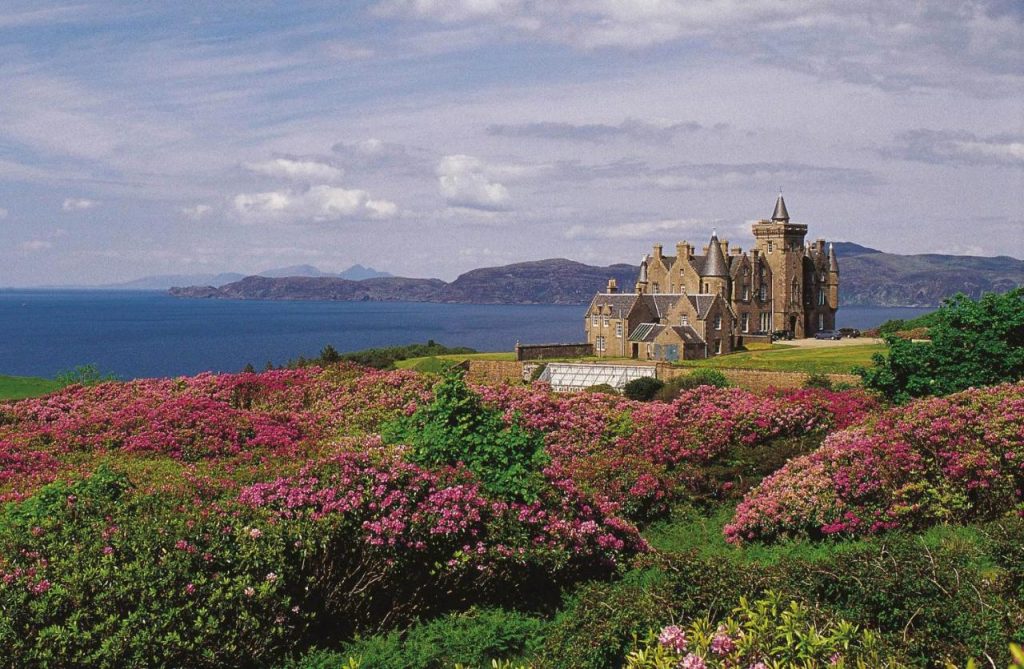
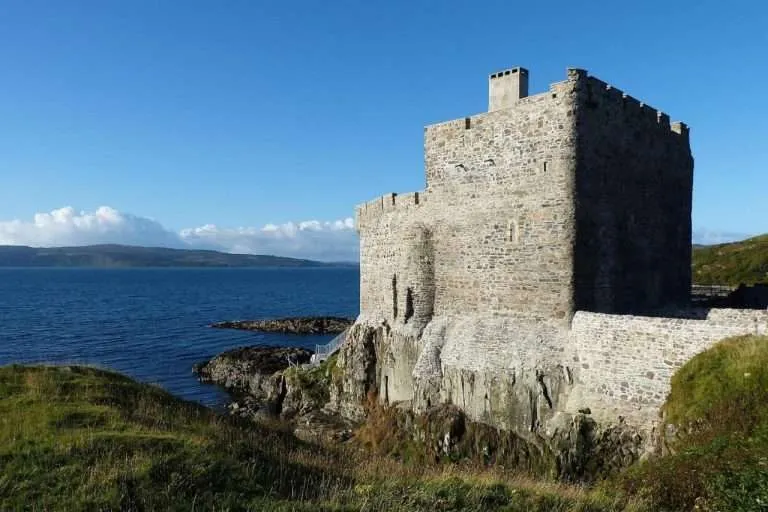
- Fabulous views: Overlooks Isle of Mull, Atlantic Ocean, and Hebridean islands.
- Choice of rooms: Self-catering apartments in the castle and former stables.
- Elegant furnishings: Warm colours, Victorian-style baths, and comfortable decor.
- Food options: Coffee shop, deli, and nearby pubs; owners provide fine whisky tastings.
- Outdoor activities: Guided walks, wildlife spotting, whale watching, and estate exploration.
- Accessible location: Northern tip of Mull, close to Tobermory with ferry access from Oban.
- Historical significance: Built in 1858 in Scots Baronial style during the Highland Clearances.
Glengorm Castle Hotel is a Victorian era Scottish Castle Hotel with fabulous views over the Isle of Mull, the Atlantic Ocean and the Hebridean islands of Coll, Barra and the Uists.
What are the rooms like?
- Apartment options: Choose from castle or former stable buildings.
- Bedrooms vary: Deluxe Apartments have one bedroom; castle apartments have two or three.
- Elegant furnishings: Semi-traditional decor with warm colours and soft furnishings.
- Classic bathrooms: Featuring old Victorian-style bathtubs.
- See each room in detail here
There is a choice of self catering apartments at Glengorm, in both the castle and in the nearby former stable buildings
The latter (listed as Deluxe Apartment on the booking page) are one bed units while those in the castle have two and three bedrooms (the maisonette and the superior apartment respectively.
All the accommodation is very nicely, semi-traditionally furnished, with warm colours and soft furnishings. Bathrooms have some nice old Victorian-style bathtubs.
And what about food? Facilities, things to do?
- No evening meals: Coffee shop & deli open Easter to November and nearby pubs available.
- Hospitable hosts: Owners are friendly and offer complimentary whisky tastings.
- Stunning grounds: Coastal paths, woodlands, and hills ideal for hiking.
- Guided walks: Opportunities for wildlife spotting and learning about Mull’s history.
Evening meals are not served at the castle but there is the coffee shop & deli in the old farm buildings open from Easter until November, and several nearby pubs and restaurants.
You’ll find the owners of Glengorm extremely hospitable and friendly and they have a great selection of fine whiskies which guests can sample for free.
The estate grounds are magnificent, with many great hikes around coastal paths, woodlands, and hills.
There are also guided walks that you join from the castle which offer great opportunities for wildlife spotting (including whale watching) and where you can learn a lot about the past and present of the estate and the Island of Mull.
How is the location? And how do I get there?
- Remote location: Northern tip of Mull, wild countryside yet close to Tobermory.
- Scenic landscapes: Moorland, mountains, and rocky coastline ideal for exploring.
- Hiking paradise: Great for walkers but weather can be unpredictable and rainy.
- Access options: Ferry from Oban takes 40 minutes and Glasgow is about two hours by car, with trains available too.
At the northern tip of the Isle of Mull, the countryside around Glengorm has a wild, beautifully remote feel.
It’s still snear to Tobermory though, the main town on the island, which is a picturesque little place that sees quite a few tourists in summer.
People come to Mull for the scenery though and it has miles of open moorland, mountain peaks, and rocky coastline to be explored.
It is an excellent place for hiking though the weather is notoriously bad; Mull gets more rainfall than any of the other Hebridean Islands and that means a lot of rain!
Still though, in some ways, the bleak, brooding skies above can actually add to the beauty of the place but of course do be prepared for the worst when venturing off into the wild.
To get to Mull there is a ferry from the town Oban, in mainland Scotland, which takes about 40 minutes to arrive in Tobermory, about five miles from the castle.
Oban is just over two hours drive from Glasgow and the journey offers some spectacular scenery, passing through some highlights of the Highlands.
Loch Lomond and the Trossachs National Park, are all on the way. If you’re not driving there are also numerous scenic trains from Glasgow to Oban.
Any interesting history I should know about?
- Highland origins: Originally Mishnish Estate, farmed in smallholdings by local families.
- Highland Clearances: James Forsyth bought the land in 1856 and evicted tenants, giving rise to the name Glen Gorm.
- Castle design: Commissioned Kinnear & Peddie in 1858 in Scots Baronial style, adorned with biblical quotes.
- Tragic fate: Forsyth died before completion; local legend attributes it to a curse.
- Ownership changes: Passed through multiple owners including the Forsyths, Lang, Cowan, Morgan, and the Lithgows.
- Restoration: Acquired by John Brockbank Carr in 1962 for renovations; Nelson family took over in 1970 and run it today.
Originally called the Mishnish Estate, the land was divided up into smallholdings farmed individually by peasant families as was the way of the Highlands at the time.
In 1856 the estate was bought up by James Forsyth, from a rich plantation family in Jamaica, who, having quickly made plans to build a magnificent castle on his new land, set about evicting the tenants.
This was pretty standard practice for rich landowners in the 18th and 19th centuries and is known as the Highland Clearances, something which changed the landscape of the Scottish Highlands forever and decimated much of the ancient Gaelic culture of the region.
The evictee’s cottages at Mishnish were then burned and the blue smoke filled the air giving rise, it is said, to the present name Glen Gorm or blue glen in English.
And what about the reviews? What did other guests like?
“One of the most beautiful castles you will see, set in a stunning location overlooking the sea, beautifully decorated, big fireplaces in every room and staff that are always there to help you! It an experience that everyone needs to live once in their lives!…”
“Straight out of an Agatha Christie novel. One of the most beautiful places I’ve ever stayed, and well worth the price of admission. In fact, this is probably the best value in all of Scotland. But its remoteness and the adventure just getting there only adds to its mystique….”