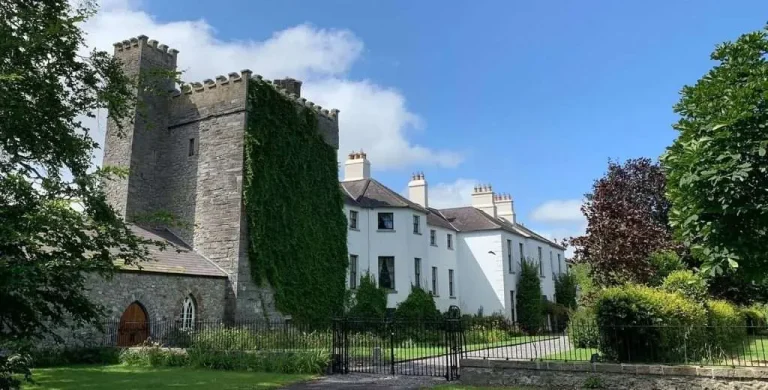
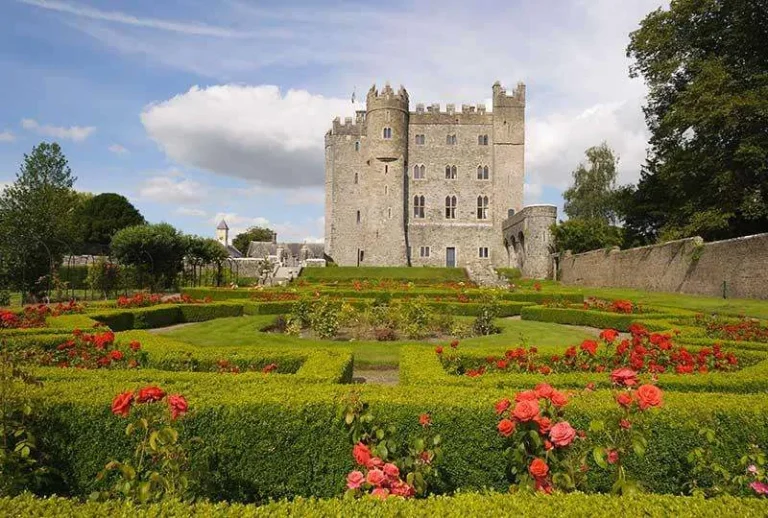
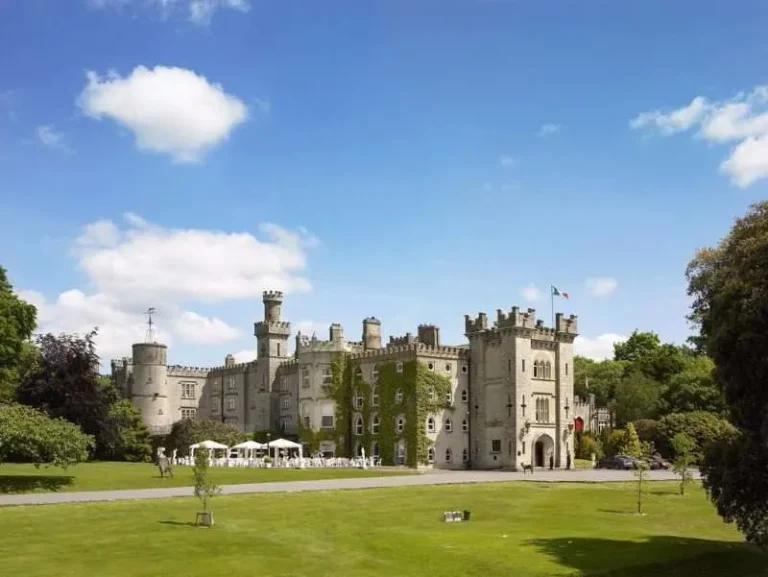
The nearest castle hotel to the centre of Ireland’s capital, Dublin, the 4-star Clontarf Castle has luxury accommodation in what is now a blend of 12th-century castle site, 18th-century manor house, and 21st-century hotel.
It takes a lot of good design to get the balance right and Clontarf Castle manages it, with the first sight of the very Celtic Tiger-looking glass entrance foyer somehow managing to not look incongruous against the ancient ivy-covered tower walls behind.
Once inside the theme continues with the bright and bold interiors balancing smartly the old and the new.
In the bedrooms, though the relatively modern usually edges it; think old-fashioned luxury city hotel rather than a classic castle hotel.
Relatively modern or not though, they are stylish and chic and all things considered, Clontarf Castle makes an excellent luxury city hotel with a historic twist.
Clontarf Castle at a Glance
- Castle: A 4-star castle hotel combining a 12th-century castle site, an 18th-century manor house, and a 21st-century hotel.
- Accommodation: Standard double rooms and executive rooms/suites, with the latter offering an adjoining seating area and four-poster beds. Rooms are nicely designed, well appointed, clean and comfortable, with WiFi, satellite TV, mini-bars, air-conditioning and plush bathrooms.
- Location: About a 10-minute drive from Dublin city centre, in the seaside suburb of Clontarf, with Dublin Airport around 20 minutes away by car.
- Dining: Fahrenheit Grill serves award-winning modern Irish food, while Knights Bar and Indigo Lounge offer drinks, food and informal socializing.
- Facilities: Small gym, complimentary access to Westwood Gym and its 50-meter swimming pool, concierge service, and an Art Trail throughout the building.
- Setting: A historic property in Clontarf, close to the sea, Dollymount Strand and two highly regarded golf courses.
- Best For: Guests seeking a stylish city hotel with a historic twist and easy access to central Dublin.
The Rooms:
The accommodation consists of standard double rooms and ‘executive rooms’ i.e. suites which have an adjoining seating area and the extra charm of a four-poster bed.
Though nothing about the rooms stands out in terms of features, in particular historic features, they are all nicely designed, well appointed, and thoroughly clean and comfortable.
Facilities include interactive satellite TV, WiFi, a well-stocked mini-bar, air-con, top-quality beds and bedding, and some rather plush bathrooms.
Facilities & Things to Do:
The common areas are lively and fun, and you can find a lot going on in the evenings. The Fahrenheit Grill is a fine dining restaurant where you’ll find some award-winning modern Irish food in an elegant setting with stained glass windows, wooden beams, and paneled walls.
For drinks, more food, and more informal socializing, there is the cosy, old-style Knights Bar and the contemporary cool ‘n chic Indigo Lounge which has an outside terrace.
Throughout the building, there are fine collections of paintings and various other artworks, with the hotel even producing its own Art Trail brochure to help visitors find their way around it.
There is a small gym at the castle too though guests may prefer to use their complimentary free pass to the much larger Westwood Gym and 50-meter swimming pool about ten minutes walk down the road.
The Location:
About a 10-minute drive from the centre of Dublin is the seaside suburb of Clontarf. A somewhat ordinary residential area that, except for the attraction of its own castle hotel, wouldn’t see too many foreign visitors.It has a nice village atmosphere though and is a pleasant place to stroll around, with the sea never very far away.
The famous Dollymount Strand on Bull Island is a very popular swimming spot in the area accessed by a footbridge from Clontarf. You’ll also find two highly regarded golf courses there; St. Anne’s and the Royal Dublin.
The name Clontarf has strong historical connotations in Ireland, for it was here, on Good Friday in 1014, that the Battle of Clontarf occurred.
Some History:
There has been a castle on the site of what we now know as Clontarf Castle since 1172. Though no trace of the original castle remains it is believed to have been built by Hugh de Lacy a recent ‘visitor’ from the Norman invasions which began in 1169 and led to a proliferation of castle building in Ireland.
Though the dates are hazy it seems that at some point ownership passed on to the secretive Knights Templar religious/military group which would hold it until their dramatic downfall all across Europe in 1308.
The more pacifist Knights Hospitaller group was granted it subsequently until they too were relieved of it by King Henry VIII during his Dissolution of the Monasteries in 1541.
It would thus end up in the care of the Crown, who would wait for a suitable Protestant Loyalist to gift it to. Eventually, in 1600, Queen Elizabeth I granted the castle and the estate to Sir Geoffrey Fenton, the then secretary of state for Ireland.
Guest Reviews:
“Absolutely Gorgeous!! Would recommend to anyone who is thinking of staying here. It is so charming and will definitely be an AMAZING addition to your vacation….”
Read all guest reviews here at Booking.com
Our Verdict
Clontarf Castle is a slightly different proposition from a classic castle hotel. We think its most obvious strength is the combination of a historic setting with the convenience of a luxury city hotel, though we realize some of you may prefer to get out into the countryside for a more immersive experience.
The accommodation is relatively modern and the bedrooms do not stand out for historic features, although the executive rooms add the charm of four-poster beds.
What makes the property special is the setting and the balance between old and new: ancient ivy-covered tower walls, stained glass, wooden beams, paneled walls, artwork and a medieval atmosphere sit alongside contemporary interiors, modern facilities and the convenience of being minutes from Dublin city centre.
We’d choose Clontarf for guests who want to explore Dublin while staying somewhere with historic character, rather than for someone whose priority is sleeping in a traditional castle interior. That distinction is important, but it is also what makes the hotel work: it offers a historic twist on a luxury city stay that a conventional Dublin hotel cannot provide.