

Most Notable Former Guests: Grace Kelly, Jacques Chirac, Queen Elizabeth II…
The magnificent walled city of Carcassonne, France, is certainly a wondrous sight.
The words ‘walled city’ can be used to refer to a huge number of cities around the world but in Carcassonne’s case the ‘walls’ are more castle ramparts than walls and so, rather excitingly, it could be said that Carcassonne is a city within a castle.
So popular is it though that the hordes of tourists that descend on it every summer can take somewhat from the experience that such a stirring sight can promise.
The walled city of Carcassonne has a, not so little, secret that those in the know can use to take in all that medieval atmosphere without the masses.
The secret is Hotel de la Cité, a beautifully crafted Neo-Gothic castle hotel tucked into the ramparts of the ancient walls.
Apart from being, in itself, a gorgeous and atmospheric property and the city’s only 5-star hotel, it gives access to the walls, which you can wander freely in the peace of the evening when the tourists have gone.
The Rooms
Hôtel De La Cité is undoubtedly Carcassonne’s best hotel, even discounting its unique setting. It is the only five-star hotel within the city walls while also hosting La Barbacane, its only Michelin-starred restaurant.
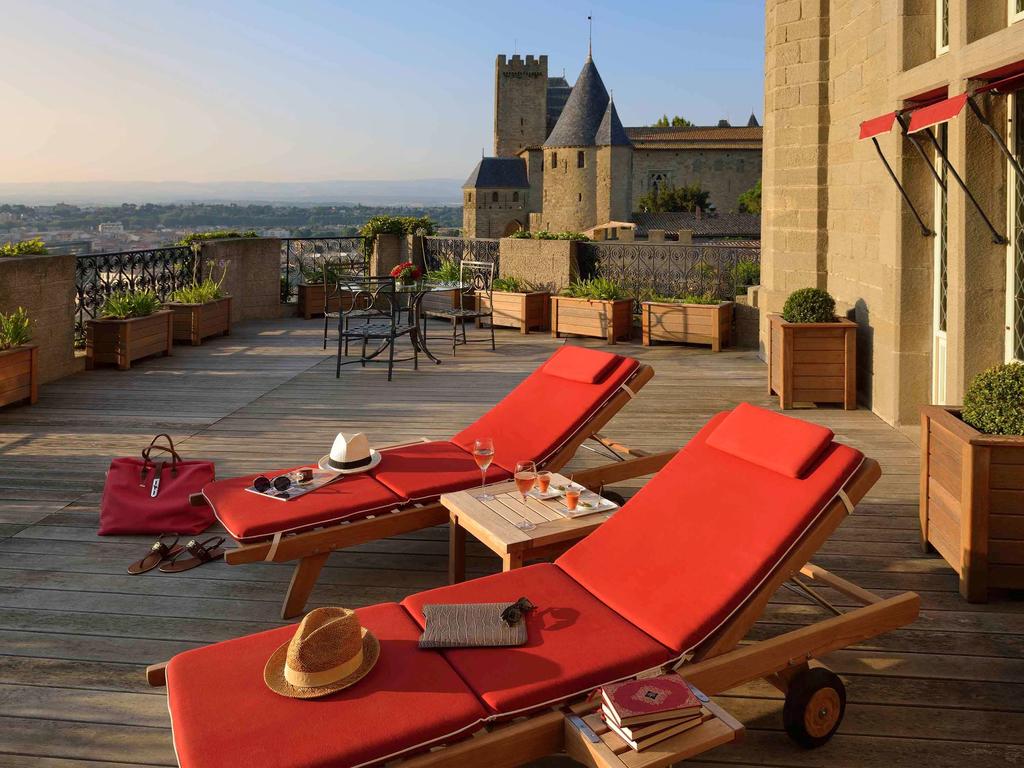
There are excellent spa facilities too, a swimming pool, and some beautiful gardens and terraces with outstanding views.
There are 59 rooms in total, split across two buildings connected by covered walkways – check your options on the booking page here.
All of them are classically styled; the hotel was opened in 1909 and that is the era that is most represented in the decor of both the rooms and the hotel generally though you will also find the odd faux medieval (it is Neo-Gothic after all), or contemporary, touch here and there.
They all have elegant marble bathrooms too and for all their Belle Epoque styling they also supply the usual modern conveniences.
On the booking page you’ll see a choice of classic rooms and the more expensive ‘superior’ rooms.
They are broadly similar internally but the superior rooms come with a nice view, and a terrace or balcony to enjoy it from.
And with the views being as they are, if you can afford it, it is worth paying the extra.
Prices:
Check out all the details on the booking page here.
Facilities & Things to Do:
Having access to the walls of Carcassonne after the tourists have left is a great plus. The lighted walkways are wonderful to stroll around at night with their sweeping views of the city below.
There are some lovely private gardens attached to the hotel also, with a heated outdoor swimming pool (open May to September) and seating areas to enjoy the views from.
The Cinq Mondes spa is another attraction with a hammam, and treatment and relaxation rooms. Various health and beauty treatments are offered and Cinq Mondes has its own unique range of natural, organic, skincare products which you can buy to take home.
As mentioned before the La Barbacane restaurant is the only Michelin-starred restaurant within the city walls and serves up beautifully crafted and presented classic dishes.
You can treat yourself to some fine cocktails at the library bar too with its floor-to-ceiling books and intimate cosy atmosphere.
The buffet breakfast is a veritable feast, with a huge selection to choose from, various dairy-free and gluten-free options, and even champagne at weekends!
Speaking of champagne there is, as you may expect, an excellent wine collection at Hotel de la Cité. They have their own wine cellar and you can organize tasting sessions with their in-house wine steward.
The Location:
One of the South of France’s most spectacular sights, Carcassonne is not to be missed. The UNESCO world heritage protected city walls are incredibly imposing, and, as mentioned above, being more castle ramparts than walls they give Carcassonne the uniqueness of being, in some ways, a city within a castle.
From its hilltop position the walled old town dominates the whole city but with the amount of visitors it receives it can be uncomfortably packed especially in the summer months.
It must be noted though that the vast majority of these visitors are day trippers on tours, and so once evening sets in the place becomes almost deserted.
This may sound like a bad thing for a more regular town or city but in the case of Carcassonne it really is a blessing.
The first walls were built in the times of the Gauls and the Romans, with substantial additions in the 13th and 14th centuries.
In the 12th century a castle, Château Comtal, was built within the walls, and it’s still there today to be seen and toured.
The Basilica Saint Nazaire, a fine example of Gothic-Romanesque architecture is also worth a look.
Beyond La Cité, as the old town is known, Carcassonne doesn’t have the richness of architecture or sights that some other cities in the South of France have, though the 13th-century Bastide Saint Louis is worth a wander around.
It is the nicest part of the so-called Ville Basse or ‘Lower City’ with its inviting central square; Place Carnot, the great Gothic cathedral of Saint-Michel, some quaint narrow streets, colourful markets, and some nice little parks and gardens.
Beyond Carcassonne, France’s fourth largest city, the ‘Ville Rose’ Toulouse, is about an hour away while the old Roman city of Narbonne shouldn’t take much more than half an hour.
The nearest airport to Hotel de la Cité is of course Carcassonne Airport just outside town from where budget airlines and others, fly to various destinations around Europe. Transfers to and from there can of course be arranged from the hotel.
Carcassonne is also on the main Toulouse-Montpellier train route which allows good access to both those cities as well as the likes of Narbonne, Beziers, Bordeaux, Marseille, Arles, Nîmes, and Quillan.
A Little History:
Though the first evidence of human settlement on the site La Cité dates back to the sixth century B.C., it was not until the 3rd century A.D. that the Romans built the first ring of ramparts there.
La Cite’s setting above the plains that lie between the Pyrenees, the Mediterranean, and the Massif Central thus had been noticed as being of great strategic importance.
In the 5th century, it was captured by the Visigoths, who added some of their own, extra, defenses. The Franks were next in line in the eighth century, again adding some adjustments and improvements.
In the 1200s a dissident religious movement known as the Cathars became very influential in the South of France, and especially in the Languedoc which was then enjoying some level of autonomy from the French crown.
The Cathars took issue with the Catholic Church leadership for what they saw as forms of immorality, including widespread corruption, something which would quickly enrage the powers that be in the Vatican.
The Pope of the time, Innocent III, allied with the King of France, Philippe II Auguste, and started a punitive crusade against them.
On July 22, 1209, during the Albigensian Crusade, they sacked the city of Beziers, resulting in the death of thousands.
A week later Carcassonne was in their sights but saved itself the same fate when the local Viscount, Raymond-Roger Trencavel, surrendered the city on Aug. 15, 1209.
Some Guest Reviews:
“What an amazing hotel! Please try the Rigola spritz! Invented by one of the best and most charismatic mixologist’s in France. What a special place!…”
“Unashamedly luxurious hotel in a fabulous location. A luxury hotel within the walls of the Cite with a Michelin-starred restaurant! Reassuringly expensive. Staff were very efficient and very friendly. Public rooms ooze comfort and class. In the evening the Cite empties of tourists and you have a medieval city to yourselves! Dinner was superb. Try their own-made digestif with your cheese….”